

Interview by Despina Dimotsi, ENGLISH EDITION 10, Fall 2026
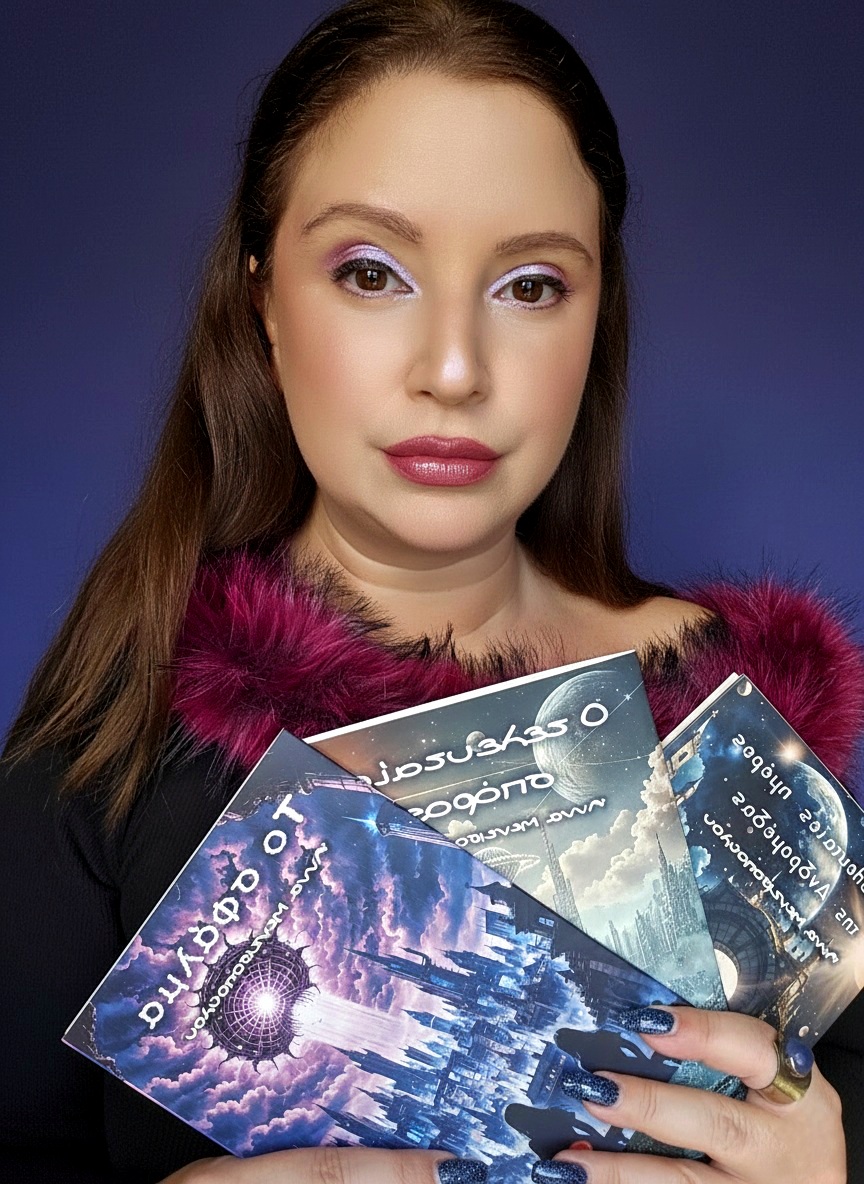
Anna Mentisopoulou was born in Volos and is an author and philologist, holding a degree in French Language and Literature from Paris IV – Sorbonne University through the French Institute of Greece (IDeF). She is fluent in both French and English and has been living in Kos in recent years.
From a young age, she taught foreign languages with passion and creativity, building more than twenty years of experience in education. At the same time, she immersed herself in the world of Argentine tango: she taught in dance schools, appeared at festivals and milongas, co-organized events, and won two gold medals in international competitions, revealing both her passion and her expressive strength. She has also maintained an active presence in public life, participating in parliamentary and local elections while serving on committees focused on education, culture, and tourism development, leaving a meaningful social impact through her work.
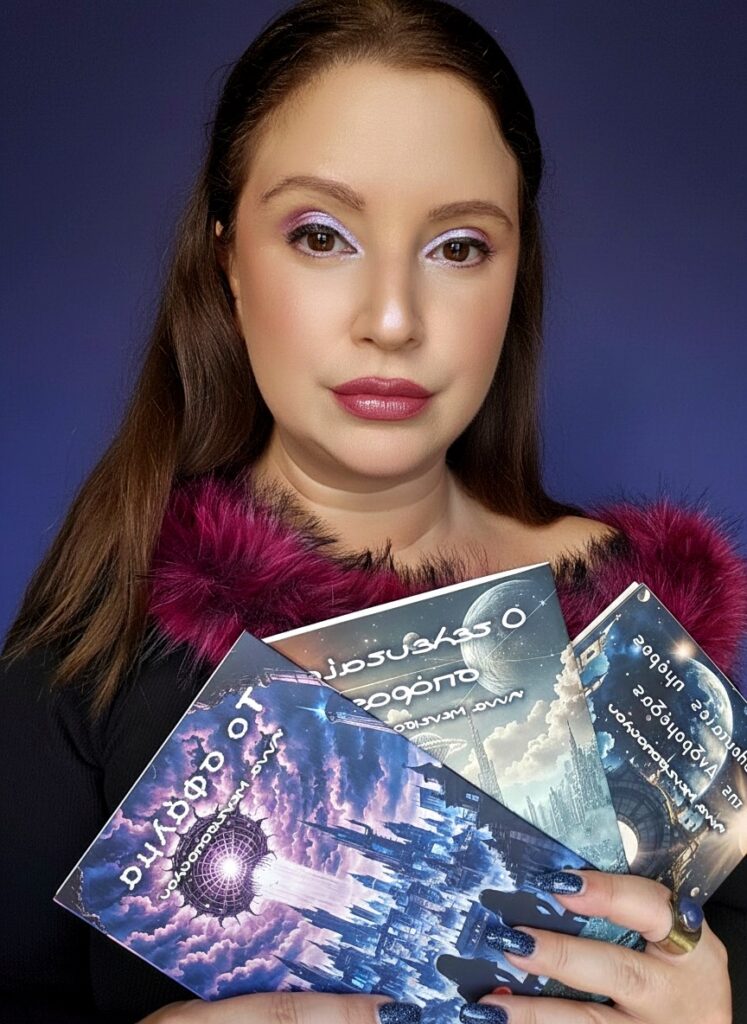
In recent years, she has devoted herself intensely to writing and to the world of science fiction. Her work moves between the lyrical and the cinematic, drawing inspiration from consciousness, technology, and the hidden memory of the universe and human existence. She writes to create worlds that preserve wonder, humanity, and transcendence in an era increasingly shaped by automation, control, and existential uncertainty. In 2025, three pocket novellas by Anna Mentisopoulou were published by Universe Pathways Editions:
The Error, a dystopian science-fiction story about consciousness and control
The Last Days of Andromeda, a space opera infused with philosophical depth
The Last Seed, a solarpunk tale of ecological rebirth and hope
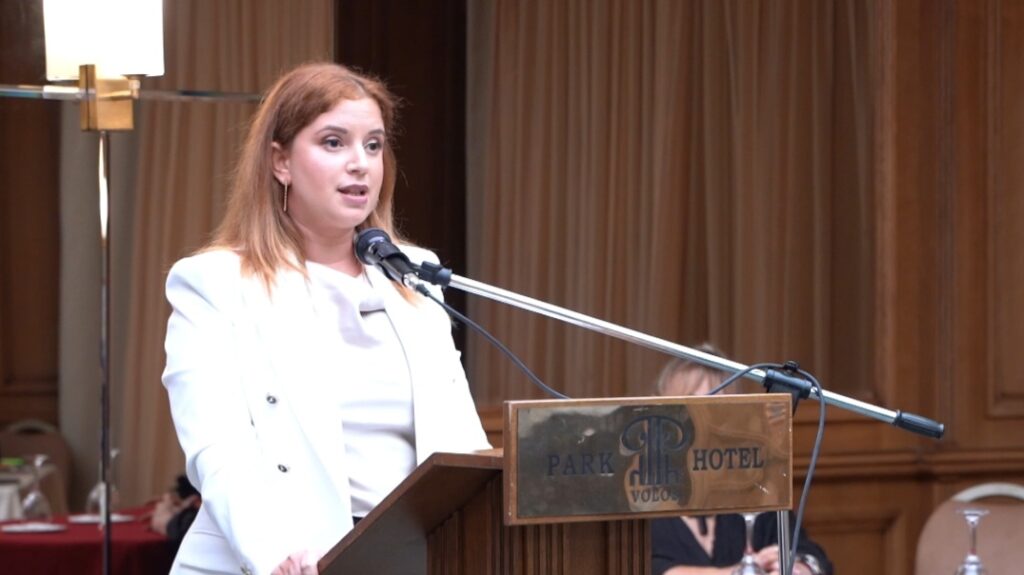
Her works were presented at the annual Faces of the Fantastic festival in Athens.
She is currently completing a new full-length science-fiction novel, a project she has been working on for over a year. At the same time, she maintains an active presence on social media and in the digital press, sharing reflections on creativity, consciousness, and inner transformation. Her work focuses on the relationship between humanity, technology, and consciousness, building narrative worlds that bridge the scientific, the transcendent, and the poetic.
DD: Anna, welcome to our magazine, which has a special love for foreign languages. We would love to hear how you remember yourself creating images and connecting imaginative stories. Did this love already exist before your studies, or did it emerge later?
ΑΜ: Since childhood, I have loved every form of art. I remember myself drawing, listening to music, moving with rhythm, and weaving stories in my mind before I could even write them down. Imagination was my natural environment, a space where I could create worlds, characters, and emotions that helped me understand reality. Over the years, I explored many art forms. Yet even though writing was always there as a deep inner need, it was also something I pushed away for years. There was a strong inner resistance: “it isn’t finished yet,” “I’m not ready,” “I can’t do it yet.” In truth, it was what I loved most and, at the same time, what I feared most deeply. My studies in foreign languages and philology gave me the tools, but not the need itself. That need already existed, clear and powerful. Today, I understand that all the arts I loved ultimately led me back to writing—not as a choice, but as a return to my essence.
DD: relation to dance, did writing and philology perhaps come first? How many years were you involved with Argentine tango?
ΑΜ: Dance entered my life just as naturally as art itself, but over time it became something far more intense and demanding than a simple creative activity. It was a way of expressing myself without words, a language of the body that taught me discipline, emotion, and presence. Argentine tango won me over above all because of its musicality, its deep connection with others in the space, and its emotional force. I was professionally involved with it for around fifteen years, working in many dance schools and taking part in performances and collaborations that shaped me both artistically and personally. For a long time, dance was a central axis of my life, a world full of movement, control, and creativity.
DD: When did you win your medals in international dance competitions? We would love to hear a little more about that.
ΑΜ: a particularly productive and defining year for me in the world of dance. During that period, I took part in international competitions where I won two gold medals—a recognition of years of work, perseverance, and dedication. At the same time, I had the joy of collaborating with well-known and established figures in the dance world, such as Richard Szilagyi from Dancing with the Stars. These experiences opened new horizons for me and raised my standards even higher. Looking back, that year marked the culmination of a long journey in dance. Shortly afterwards, that cycle came to a conscious close for me, after fifteen years of professional involvement—not as a withdrawal, but as the completion of an important chapter of my life.
DD: How did your involvement in politics begin? And how did you combine it with offering something meaningful in the fields of education and culture? What vision and plans did you have for Kos?
ΑΜ: My involvement in politics was not something I had planned from a young age. It began unexpectedly, through a proposal I received during the pandemic, at a time when I felt I could not remain inactive in the face of everything happening around us. So I took part in parliamentary elections with a political party that, at the time, I believed could express my need for greater humanity and clearer thinking. That experience became the foundation for the next step in my path, within local self-government in Kos—a place I deeply love and where I have lived for years. There, I tried to contribute in a meaningful way through actions and proposals in the fields of education and culture, with a vision of a society that is more alive, more creative, and more humane. I continue to believe in a Kos that invests in knowledge, culture, and its young people. For me, politics was never an end in itself, but rather a means of offering something and participating in public life—a chapter that shaped me and taught me a great deal.
DD: The stories that stood out in 2025 carry a sense of metaphysical transformation, while also projecting hope for humanity. How close is the fantastic to the changes we are experiencing every day as a society? Based on your own experiences and your relationship with writing, where do you think all this is leading?
ΑΜ: For me, the fantastic is not an escape from reality; it is a mirror of it. Through stories set in the future, in dystopia, or in science fiction, I try to speak about what we are already living through as a society: alienation, technological dependence, fear of change, but also the need for hope and awakening. The changes we experience every day are so rapid that they often already resemble science-fiction scenarios. Artificial intelligence, humanity’s growing distance from nature, the loss of meaningful communication—all of these find their place in my work, not only symbolically, but directly. What I want to offer readers is not fear, but awareness—and alongside that, hope. Even in the darkest landscapes, there is always a seed, an opening, a possibility for evolution and reconnection with our human essence. I deeply believe that literature can prepare us for the future—not by predicting it, but by helping us face it with greater awareness and sensitivity.
DD: We would love for you to share a small secret about your new story. And of course, when should we expect it to be released?
ΑΜ: One small secret I can share is that my new story continues to move in the deep waters between science fiction and the memory of human consciousness. It explores how our choices—both personal and collective—can change not only the future, but also our very idea of humanity. Without revealing too much, this time the world I am building is not simply far away; it feels unsettlingly close. If everything unfolds as I envision it, I expect it to be released sometime in 2026—a year that, for me, marks a new creative phase.
DD: What have you been focusing on during this period apart from the story? Is there a possibility that we may see your work published in English and French?
ΑΜ: During this period, I have devoted myself almost exclusively to writing. It is a phase of my life in which all my previous cycles—art, dance, personal experience, and public activity—converge and transform into stories. At the same time, I am working on a new novel, completing existing projects, and continuing to explore deep themes related to the future of humanity, consciousness, and the transformation of society. As for international editions, this is something I have had in mind for quite some time. There is real potential for my work to be translated into both English and French, which is especially meaningful to me, as from the very beginning I have written with an international perspective, not only within the narrow boundaries of Greek literary reality. The idea of my work traveling beyond borders feels like a natural continuation of this writing journey—and a dream that now seems closer than ever to becoming reality.
DD: How do you imagine Anna ten years from now? As a writer, but also as a person more generally—what should we expect in the years ahead?
ΑΜ: Ten years from now, I imagine Anna even more deeply rooted in writing, with more books, more stories that have traveled to other countries and other languages, yet always centered on the same core: the human being, consciousness, and the need for evolution. I would like to have created a body of work that speaks to people, challenges them, brings them together, and inspires them. Not simply to write stories, but to open conversations about the future of society, technology, and human nature. On a personal level, I see someone calmer and more creatively free. Every cycle of my life so far—art, dance, politics, writing—has taught me something valuable. In the years ahead, I want all of these elements to continue coming together through a deeper truth. If there is one thing I can promise, it is that the journey is only just beginning.