

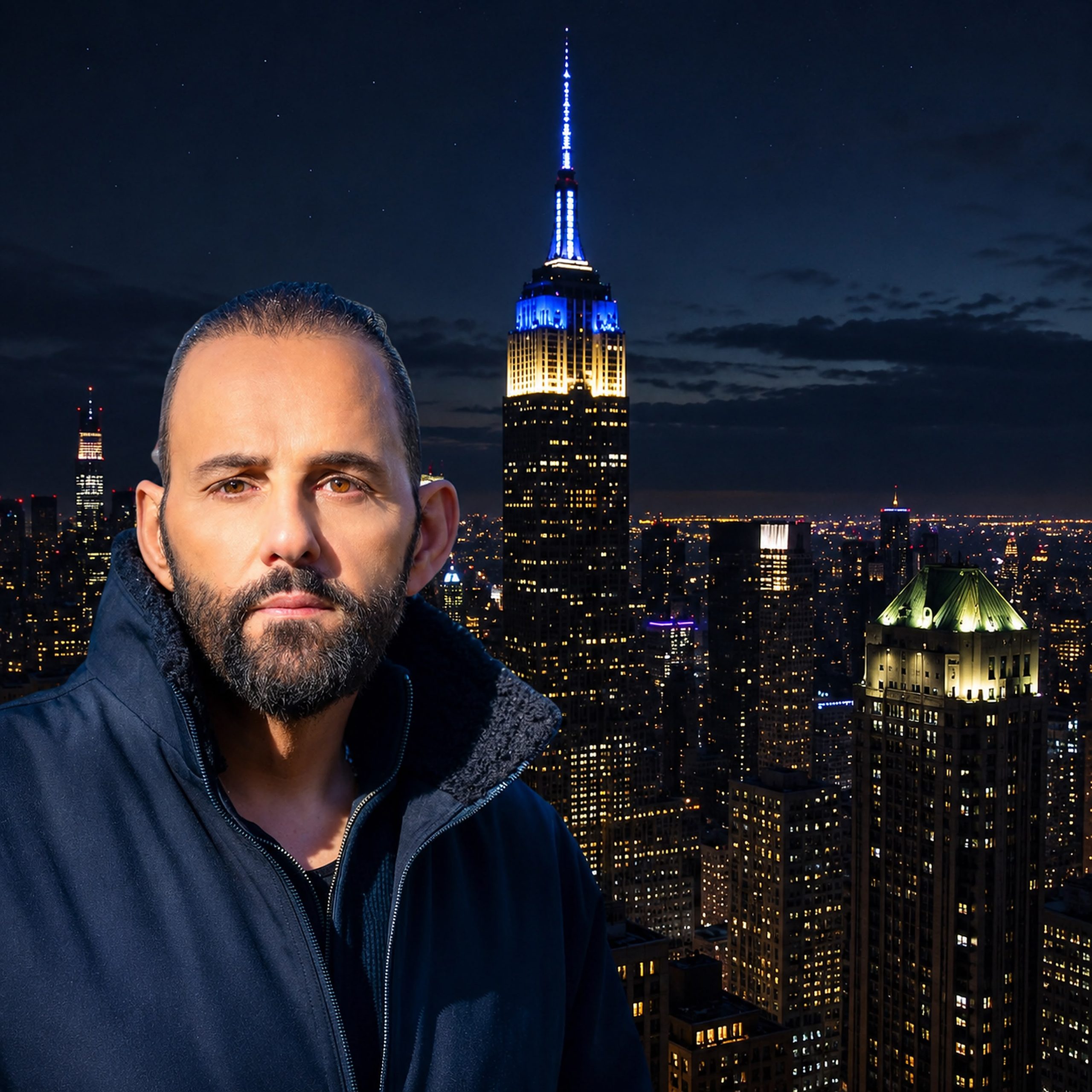
Exclusive interview by Despina Dimotsi. English edition, Issue 10, Fall 2026
George Zouvelos is an American filmmaker, actor, writer, director, producer, narrator, composer, screenwriter, and author whose work is rooted in authentic New York City storytelling. A lifelong Astorian of Greek heritage, he has built a career dedicated to independent filmmaking that values truth, character, and emotional honesty over spectacle.
He is the creator of the Once a Week for Life trilogy, an ambitious three film crime saga that he wrote, directed, produced, narrated, composed, and stars in as NYPD Lieutenant Adam Galanis. Blending elements of Greek tragedy with the traditions of Sidney Lumet, Francis Ford Coppola, John Cassavetes, Martin Scorsese, and classic American drama, the films have earned praise for their raw authenticity, memorable characters, and distinctly New York voice.
Publications have praised Zouvelos’s work as raw, grounded, character driven, emotionally realistic, and uncompromisingly independent, recognizing a filmmaker whose firsthand knowledge, creative ownership, and distinctly New York voice give his writing, acting, and direction an unusual degree of credibility and emotional truth. Audience response has also been strongly positive. As of July 2026, Once a Week for Life holds an 8.0 out of 10 rating on IMDb, an encouraging result for an independently produced and distributed feature film. Viewers have responded especially to the film’s authentic New York atmosphere, dark humor, memorable characters, ensemble cast, emotional honesty, and refusal to romanticize either organized crime or police corruption.
The first film in the trilogy, Once a Week for Life, was released on April 14, 2026, and is available on Amazon Prime Video, Apple TV, DISH, DIRECTV, YouTube, Google Play, Optimum, and Rakuten. It is currently available across the United States, Canada, and the United Kingdom, with continued expansion throughout North America. Its distribution is moving toward Central and South America, while the film continues working its way through Europe, Australia, and New Zealand, with eventual expansion into the Far East anticipated.
The second film, Once a Week for Life II, has been completed and is expected to be released around Thanksgiving. The third film, Once a Week for Life III, has already been written and is presently being cast.
Zouvelos continues to develop the trilogy alongside original music, books, the official motion picture soundtrack, and additional motion picture projects through Fiat Lux Film Studios NYC.
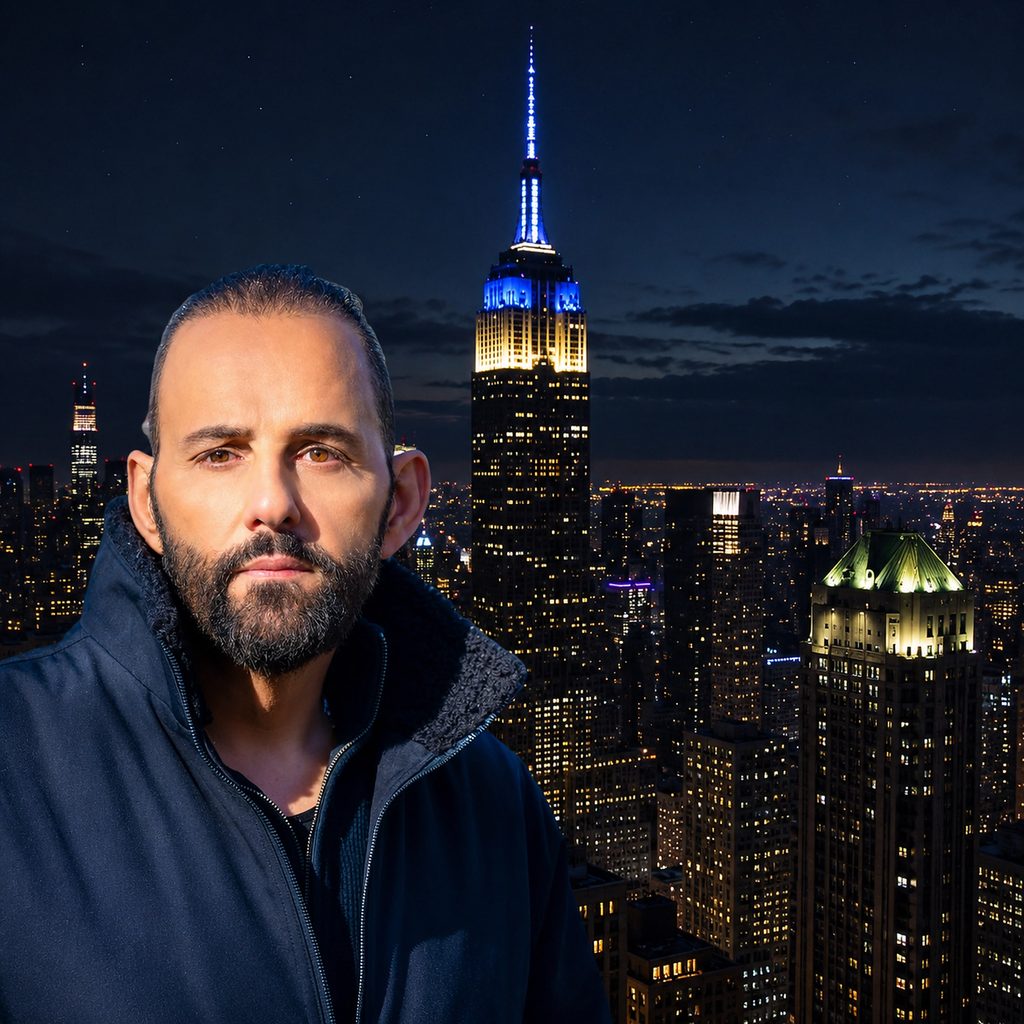
DD: We are delighted to welcome you to our magazine. Could you tell us how your Greek heritage has influenced your work in independent filmmaking?
GZ: Thank you. It is a pleasure to speak with you. My Greek heritage influences my work profoundly, not as ornament or nostalgia, but as part of its intellectual, moral, and dramatic foundation. Homer, The Odyssey, and the figure of Odysseus are central to how I understand Lieutenant Adam Galanis, whom I portray in Once a Week For Life®.
My first two films begin in a very Homeric manner: “Today’s a year since I put to sea. I turned my back and ceased to care, and my troubles, they stayed away. Yet the pains escaped have returned and are raw as if they were today’s. I feel that I will revert to that yesterday’s man and erase one speaking today. I will explain.” That opening immediately establishes Adam as a man in exile from himself. Like Odysseus, he has gone to sea, figuratively and spiritually, attempting to escape his past and the consequences of his own choices. He believed that distance, indifference, and isolation might protect him, but the wounds he fled have returned with their original force. His journey is therefore a Homeric nostos, a difficult return home, except home is not merely a physical place. It is his conscience, his identity, and the man he once was, or perhaps still hopes to become. The Odyssey begins, “Ἄνδρα μοι ἔννεπε, Μοῦσα, πολύτροπον,” translated as, “Tell me, Muse, of the man of many turns.” That word, polytropos, is essential. Odysseus is the many sided, much traveled man who survives through intelligence, endurance, adaptability, instinct, and metis, strategic cunning. Adam Galanis is conceived as a modern day Odysseus. He moves through a merciless life while balancing on a razor’s edge, struggling to distinguish law from justice, loyalty from complicity, and survival from moral surrender. Odysseus returns to Ithaca only to discover that the war has followed him home. Adam is also a warrior still fighting within his own homeland, and his battles are physical, emotional, psychological, moral, and spiritual.
He carries guilt for the collateral damage caused by his addictions, recklessness, anger, and choices. He is a fundamentally good man, but he is not an innocent man. He understands that some of the people around him have suffered because of what he has done, what he has failed to do, and the man he allowed himself to become. He is trying to find his way back to himself. In Book Twenty of The Odyssey, Odysseus commands himself, “τέτλαθι δή, κραδίη,” translated as, “Endure, my heart.” That imperative could stand at the center of Adam Galanis’s existence.
My Greek inheritance also extends through Aeschylus, Sophocles, Euripides, Aristophanes, Thucydides, and Plutarch. They examined justice, vengeance, conscience, power, civic responsibility, psychological injury, humor, and human conduct. Those concerns remain central to serious drama. My education in history, filmmaking, and acting, together with my years of public service and community involvement, informs how I understand character, power, responsibility, and consequence. My Greek heritage is not something placed around the edges of my work. It is part of its blood.
DD: Could you tell us a bit about your Once a Week For Life® trilogy? It is an ambitious three-film crime saga that you wrote, directed, produced, narrated, and scored, and in which you star as NYPD Lieutenant Adam Galanis.
GZ: Once a Week For Life® is a three-film New York crime saga about family, loyalty, corruption, guilt, faith, revenge, justice, and redemption. At its center is Lieutenant Adam Galanis, a wounded, intelligent, reckless, and morally complicated man. He has spent much of his life operating inside systems where legality, justice, morality, and institutional necessity do not always coincide. I created, wrote, directed, produced, narrated, composed, and starred in the film because I wanted to preserve a unified artistic vision. We do not ask permission, and we do not beg for forgiveness. The work is real, raw, and honest. I serve no corporate master, and there is no hidden corporate agenda directing the story, the performances, or the point of view. That independence also makes me responsible for every decision. I cannot blame a studio, a committee, a focus group, or a marketing department. The choices are mine, and I stand behind them.
My professional life is also grounded in the institutions of film, television, and theatre. I am a SAG-AFTRA actor and a member of Actors’ Equity Association. My professional affiliations also include New York Women in Film & Television, the American Film Institute, the New York Chapter of the National Academy of Television Arts & Sciences, the International Screenwriters’ Association, and Alpha Phi Delta National Fraternity. I have also had the privilege and professional responsibility of serving as a judge for the Emmy Awards through the New York Chapter of the National Academy of Television Arts & Sciences. These affiliations represent different disciplines within the entertainment industry, but they share a commitment to professional standards, artistic excellence, education, collaboration, and the protection and advancement of artists. They have also expanded my understanding of acting, writing, directing, producing, and the responsibility that comes with creating work for an audience.
The trilogy features gifted, award winning actors, many of whom brought real life experience and a deep understanding of the people and institutions being portrayed. We filmed entirely on location in New York City, primarily in Astoria and throughout the city. New York is not merely a backdrop. It is the perfect canvas for Adam Galanis because it reveals where he comes from, where he lives, and the world in which he operates. The streets, churches, homes, restaurants, offices, waterfronts, and neighborhoods possess memory, history, class, culture, beauty, violence, and contradiction. Nothing is pretentious, and nothing is manufactured. We are not attempting to imitate New York from a safe distance. We are filming inside the living city. Although it is a crime saga, crime is the external pressure. The deeper subject is conscience, what people have done, what they have failed to do, what they have destroyed, and what they may still have time to repair.
DD: With the first film now out, when can audiences expect the next two installments of the Once a Week For Life® trilogy to debut?
GZ: The first film is now available through major digital and video on demand platforms in the United States, Canada, the United Kingdom, Ireland, and a growing number of international territories. Through my relationship with Trinity Content Partners in the United Kingdom, it will soon become available throughout Europe, followed by Australia and New Zealand. The film has also been translated and dubbed into Spanish so that our friends throughout Latin America, including Central and South America, will be able to experience it with actors speaking in Spanish.
The second film has been completed, and we are working toward a release in November, before Thanksgiving 2026, subject to the schedules of our distributors and the individual platforms. The second installment expands the history of the characters and reveals relationships and circumstances that were only partially understood in the first film. It also places Adam under greater emotional, psychological, and moral pressure.
The screenplay for the third film has been completed. It brings together the familial, criminal, political, emotional, and spiritual consequences established throughout the trilogy. The third film has not yet been photographed, so I will not announce an artificial release date merely to create publicity. Independent filmmakers must be ambitious, but we must also be truthful. It will be released when it has been properly financed, cast, produced, photographed, edited, scored, and completed. Each film is designed to stand independently. An audience should be able to enter through any installment and understand the story. However, when the trilogy is viewed in its entirety, the larger architecture and the full consequences of Adam Galanis’s journey become visible.
DD: The Greek contribution to global cinema is undeniable. How do American audiences, and international filmgoers as a whole, embrace Greek productions today?
GZ: Greek cinema possesses an extraordinary dramatic and intellectual inheritance, but its importance does not belong only to antiquity. Greek and Greek-American filmmakers such as Michael Cacoyannis, Theo Angelopoulos, Costa-Gavras, John Cassavetes, and many contemporary directors have brought Greek perspectives to international cinema through tragedy, political storytelling, psychological realism, satire, and formal experimentation.
American and international audiences are increasingly receptive to films that emerge from specific cultures and refuse to dilute themselves into generic products. Audiences do not necessarily require cultural familiarity. They require emotional truth. The more specific a film becomes, the more universal it can become. A story rooted in Athens, a Greek village, an immigrant household, or the streets of Astoria can speak to people everywhere because family, mortality, ambition, exile, love, betrayal, faith, and injustice do not belong to one nationality. Digital distribution has created extraordinary opportunities for independent productions to reach audiences across continents. However, Greek cinema still requires stronger international promotion, distribution, investment, and institutional support. Greek identity must also be allowed to exist beyond folklore and postcard imagery.
Greek filmmakers must be free to examine politics, faith, history, immigration, class, violence, sexuality, family, and moral ambiguity without being expected to create a sanitized or commercially convenient version of Greece. International audiences embrace Greek productions when filmmakers trust their own voices. We should not imitate what we believe the international marketplace expects. We should create honestly and allow audiences to recognize themselves within the specificity of the Greek experience.
DD: You serve as the President of the AHEPA Hermes “John Cassavetes” Chapter in Astoria, having been a dedicated member of the organization for more than 35 years. Could you share what this lifelong commitment means to you, and how vital AHEPA’s mission is for the Greek American community?
GZ: My commitment to AHEPA has extended across nearly my entire adult life. For more than 35 years, AHEPA has represented service, education, philanthropy, civic participation, fellowship, and the preservation of Hellenic principles. AHEPA helped generations of Greek immigrants and their descendants participate fully in American civic life while maintaining pride in their heritage, history, faith, and identity. Being Greek and being American are not competing loyalties. The principles associated with Hellenism, democracy, education, civic responsibility, freedom, service, and human dignity are also central American principles.
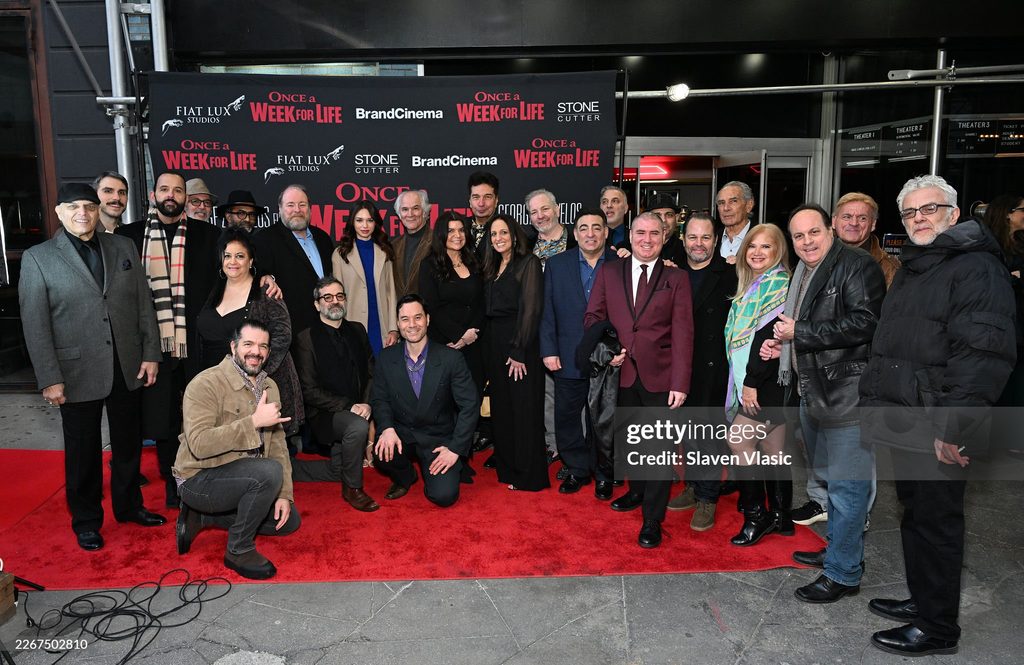
My commitment to service, however, began long before I assumed leadership within AHEPA. It began through my early upbringing at Saint Demetrios Greek Orthodox Cathedral of Astoria, where my faith, Hellenic identity, and understanding of responsibility to others were first formed. The church taught me that community is not merely where one worships or gathers socially. It is something each generation has an obligation to protect, strengthen, and pass forward.
That foundation continued through Boy Scout Troop 23 of Astoria, Boy Scouts of America, where I learned discipline, preparedness, leadership, teamwork, and service. I also volunteered in hospitals and nursing homes, experiences that taught me compassion, patience, humility, and respect for people during some of the most vulnerable periods of their lives. I later served with the Astoria Community Volunteer Ambulance Corps, working alongside fellow Hellenic Americans and members of the broader community to assist our neighbors during emergencies. I was also involved in civilian neighborhood patrols, where I accepted increasing responsibility and was eventually promoted to sergeant. Those experiences taught me that public service requires more than good intentions. It requires discipline, dependability, judgment, courage, and a willingness to respond when other people need help. I was also involved in the early establishment of Athens Square Park in Astoria as one of the original volunteers and contributors who helped found it. I later served as the park’s warden, helping to protect and support a public space created to honor Hellenic culture, history, philosophy, and the Greek American presence in New York City. My involvement continues today as I work to promote the park, preserve its cultural importance, and increase its visibility through digital marketing, community outreach, and public engagement. Serving as President of the Hermes “John Cassavetes” Chapter in Astoria carries particular meaning for me because Astoria shaped my family life, my faith, my public service, my community involvement, and my filmmaking. John Cassavetes demonstrated that independent cinema was not an inferior form of filmmaking. It was an assertion of artistic freedom and personal responsibility. He created films about difficult, contradictory, recognizable human beings, and he refused to surrender his voice to commercial expectations.
AHEPA remains essential because communities do not preserve themselves through sentiment, slogans, dinners, or photographs alone. They require active participation. We must mentor younger generations, support education, preserve our history, serve those in need, protect our institutions, and remain active within the broader civic community. My work through AHEPA, Saint Demetrios Greek Orthodox Cathedral, the Boy Scouts, hospitals, nursing homes, emergency medical service, civilian patrols, Athens Square Park, and the wider Astoria community represents one continuous life of service. My community involvement and my filmmaking are not separate lives. Both concern memory, responsibility, identity, service, and what we intend to leave behind.
DD: Beyond writing and directing, you also compose the original music and write companion works for your projects. How does the musical score develop alongside the script?
GZ: The music frequently begins while I am still writing the screenplay. I often hear the rhythm of a scene before I complete the dialogue.
Language has tempo. Actors breathe according to thought, resistance, emotion, memory, fear, and intention. My acting training makes me attentive to that rhythm, while my filmmaking education helps me understand where music can deepen an image and where it can become intrusive. I do not regard the score as decoration placed beneath a completed film. It is part of the dramatic construction. A theme may emerge from a character, a relationship, a memory, a wound, or an unresolved moral question. It may first appear with warmth and later return in a darker, heavier, or fragmented form after the character has changed.
Adam’s music often expresses what he refuses or is unable to say. He contains guilt, grief, anger, tenderness, love, and memory until they become almost physically burdensome. The score reveals part of that interior life without forcing him to explain himself through dialogue. Music must also exercise restraint. It should not order the audience to feel something the scene has failed to earn. Sometimes silence is the most truthful score. My companion writings allow me to explore character, history, moral philosophy, Greek American identity, New York, music, faith, and independent filmmaking beyond what can be contained within the running time of a film. The screenplay, performances, direction, score, and written work are separate forms, but they emerge from the same dramatic world.
DD: Looking ahead, what are your ultimate goals and expectations for your Once a Week For Life® trilogy once the entire saga is completed?
GZ: My first obligation is to complete the trilogy honestly and preserve the integrity of the work. I want the three films to form one coherent saga while allowing each installment to possess its own dramatic identity.
The audience should be able to enter through any film, but those who experience the complete trilogy should discover a larger design involving memory, family, guilt, justice, vengeance, faith, consequence, and redemption. I want the trilogy to reach the widest possible international audience, but international reach must not require artistic surrender. I will not remove the cultural, regional, personal, or spiritual identity of the films in order to make them appear more commercially acceptable. I also want the trilogy to preserve a particular New York. Cities change rapidly. Neighborhoods disappear, institutions close, buildings are demolished, languages fade, and entire ways of life can vanish within a generation. Cinema can preserve not only streets and buildings, but gestures, voices, relationships, social codes, and memory.
Ultimately, I want Once a Week For Life® to endure as a substantial work of American independent cinema, informed by Greek dramatic tradition, Greek American experience, New York history, public service, and the moral complications of lived experience. I hope audiences continue debating Adam Galanis. Was he justified, was he reckless, was he loyal, was he selfish, did he protect people or destroy them, was he capable of redemption, and did he finally find his way home? Serious drama should not relieve the audience of judgment. It should compel the audience to participate in it. The final goal is not merely to complete three films, but to leave behind a coherent body of work about wounded people who continue searching for a path back to conscience, community, love, and themselves.