Interview by Despina Dimotsi. Issue 9, English edition
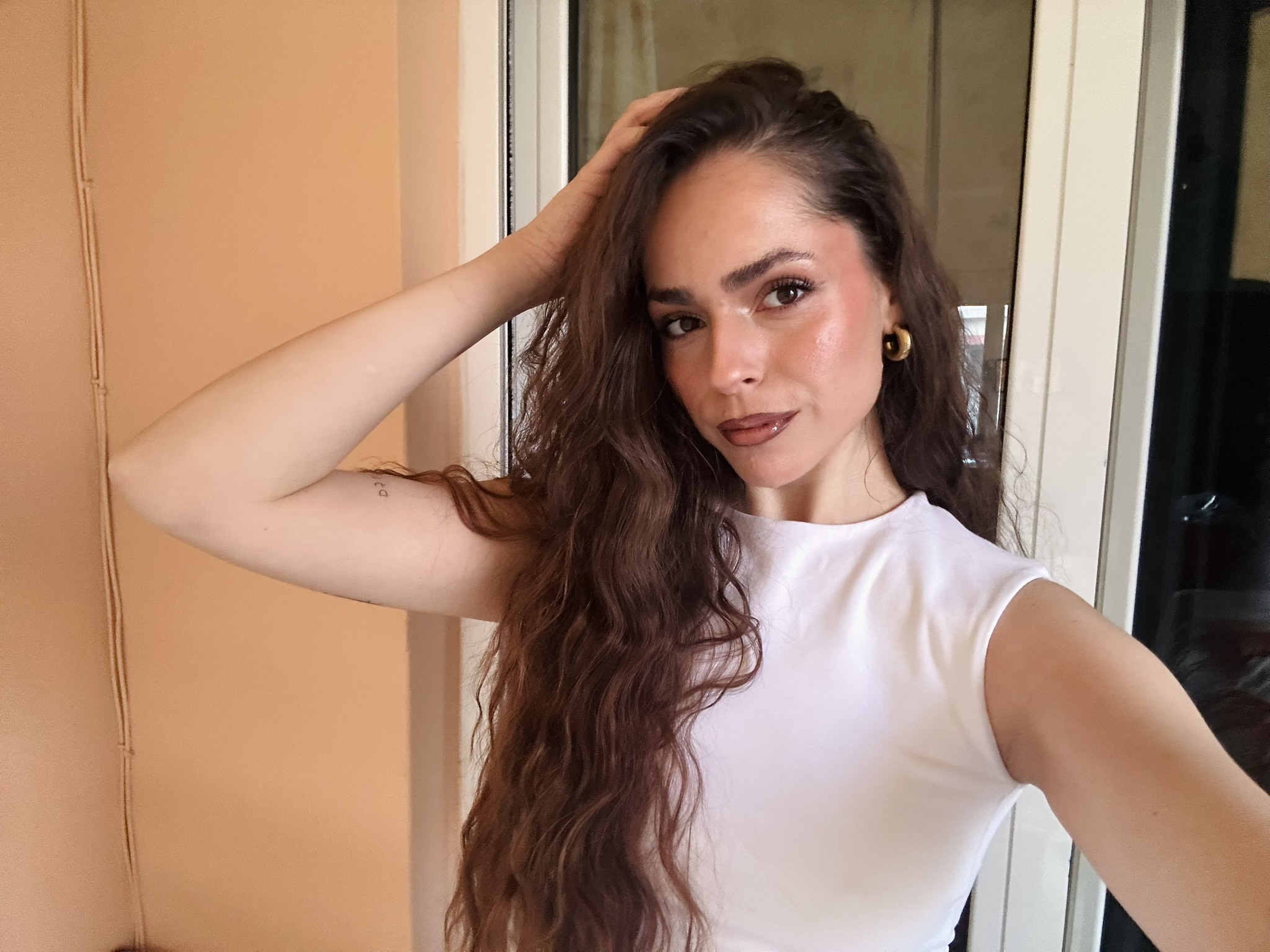
Mariza Floratou was born and raised in Patras.
She holds a multidimensional academic profile, having studied Spanish Language and Literature as well as Physical Therapy. She is also fluent in both English and Spanish. Her professional life combines these fields; she works as a physical therapist and she is a professional dancer and choreographer in various schools and conservatories.
Her active involvement in social and community volunteering was explicitly cited by the selection committee as a key factor that strengthened her candidacy. The committee emphasized that she was not chosen solely for her appearance, but for her personality, academic background, and professional achievements in physical therapy and dance.
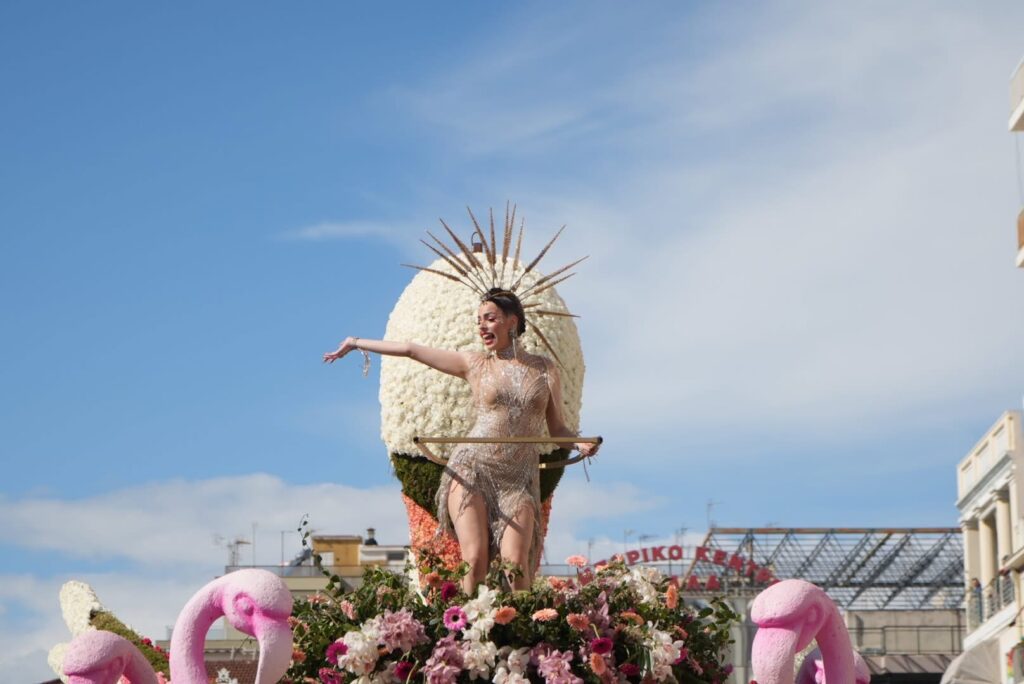
The Flower Carriage is one of the most historic and beloved elements of the Patras Carnival, and its 2026 design.
The use of 30,000 fresh carnations is a long-standing tradition for this specific float, requiring intense manual labor by the artists of the Carnival Workshop to pin each flower individually just before the parade. The swan and flamingo motif was chosen to symbolize elegance and the arrival of spring.
DD: Welcome to our magazine! We would love to hear your impressions of this year’s Patras Carnival, where you held the honorary title of ‘Carnival Queen.’ How did this year’s experience compare to the previous years you’ve participated?
MF: Without a doubt, for me it was a special year, a special Carnival, one I’ll remember forever! It was something completely new. In previous years, as a member of a group, I experienced those moments with my friends. This year, on the Queen’s float, I felt like a link between the audience and the carnival participants. I felt immense honor, joy, but at the same time a huge sense of responsibility; however, I believe that… all’s well that ends well. Everything was wonderful, and I’ll remember it forever!
DD: How much preparation was required for this year’s events to achieve that spectacular presence on the Flower Carriage?
MF: In reality, preparations for every Carnival begin many months before the final weekend, so that when the time for the parades arrives, everything is perfect. Personally, as Queen, I began participating in the preparations—which included the float—immediately after my selection. However, as I mentioned, the preparation of my float had begun much earlier.
DD: Was it a childhood dream of yours to become the Carnival Queen, or did the idea emerge later through your involvement with dance?
MF: My dream since I was little has simply been to participate in the Carnival. I’ve been doing this since… before I was born, while still in my mother’s womb, right up until now. I love the Carnival, I love my city, and I want to be in Patras every year to take part. Declaring my candidacy for Queen was a spur-of-the-moment decision, and ultimately a choice that filled me with experiences that will remain indelibly etched in my heart!
DD: How have you managed to balance such a diverse background, from physical therapy to dance and foreign languages?
MF: The truth is that anything is possible, as long as you have the will and the organization. I started studying dance at a very young age, alongside school and foreign languages. When I finished school, I decided to study Spanish literature, and then, when my schedule allowed, I began my studies in physical therapy. Dance was my stress reliever, my “safe haven”! Anything is possible, as long as you have the will, the desire, and a smile!
DD: In terms of learning, how does Sign Language differ from traditional foreign languages? What advice or techniques would you give to a beginner?
MF: Sign Language may seem a little more difficult than a foreign language at first, because it is not based on sound but on hand movements and facial expressions. For us hearing people, it’s like discovering a whole new world of communication, a little different from what we’re used to. Nevertheless, with practice, it becomes more and more natural. It is very helpful for a beginner to watch videos, practice simple everyday phrases, and, above all, interact with deaf and hard-of-hearing people. Through real-life communication, one learns the language much more easily and effectively.
DD: Your volunteer work has been a consistent part of your life for several years. What inspired you to start, and what are your long-term goals regarding your social contribution?
MF: In my opinion, real change in society begins with individual initiative. Volunteering is the way to turn empathy into action. It is not merely an activity, but an investment. Personally, volunteering taught me the value of giving without expecting anything in return and equipped me to face challenges with composure and solidarity. I started with simple actions, such as donating blood or collecting food for earthquake and flood victims, etc. In the future, I aspire to be able to even organize my own initiatives or events.
DD: Looking ahead, what are your goals for your professional path and the many initiatives you are involved in?
MF: As for volunteer work, I will continue to participate with the same enthusiasm wherever I can, until the time comes when I hope to be able to organize my own initiatives, as I mentioned, while of course continuing to help elsewhere, just as I do now. Professionally, I have already started working as a physical therapist, and starting next year, I would like to add dance classes to my schedule, as I’ve missed interacting with children. I’ll say it again so readers remember: with enthusiasm, organization, and a smile, anything is possible!