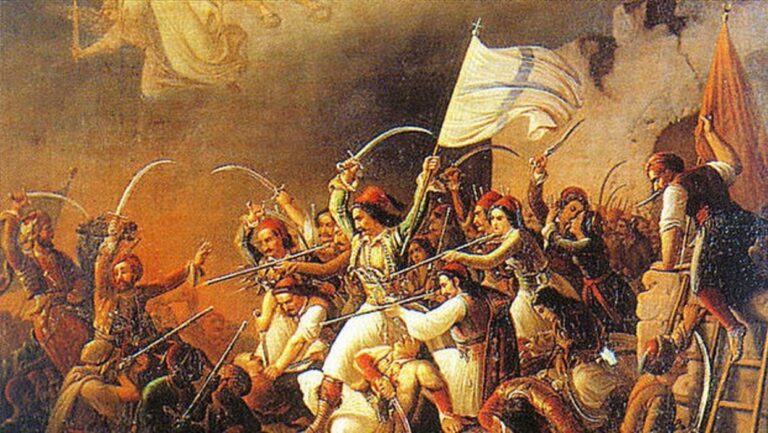
Writing about Messolonghi is a daunting task, not for a lack of facts, but because the weight of what happened there defies the reach of language.
By the spring of 1826, the city was a ghost. A full year of siege had ground everything down. With the fall of Vasiladi, Aitoliko, and Dolmas, the perimeter of hope had shrunk to the city walls. Inside, the “Free Besieged” lived on a diet of shadows—starvation and exhaustion were their only constants. They watched the horizon until their eyes burned, waiting for a fleet that would never crest the waves.
Then came the decision. On the night of April 10, the Exodus was not a desperate flight for survival; it was a refusal to exist in chains. They didn’t charge into the Ottoman lines because they thought they would live—they charged because they could no longer bear the thought of surrendering. In that darkness, they didn’t just exit a city; they exited the realm of the defeated and entered the realm of the eternal.
Men, women, and children stood as one—a collective heartbeat in the terrifying silence of the night. They moved with the quiet focus of those who had already said their goodbyes, knowing, perhaps from the very first step, that the path ahead was a narrow one. But the night had eyes. The betrayal had already traveled across the lines, and the enemy sat waiting in the tall grass. What followed was a descent into the visceral: the sudden, jagged roar of gunfire, the screams lost in the smoke, the crushing weight of the dark. In the end, only a few shadows slipped through the chaos into the mountains. They were the ones left to tell the world that Messolonghi hadn’t been conquered—it had simply ceased to be.
Two hundred years have passed, yet the air there still feels heavy with that choice. You’ve touched on the very reason Messolonghi is a sacred symbol rather than a mere historical footnote.